- June 1, 1945
- The Oranges Are Sour
- Post-Script
- Tales Of Iwo Jima – Eduard’s 1/48 Scale P-51D
- Gallery
- References and Sources

June 1, 1945
By the 1st of June the 7th Air Force had completed fourteen VLR (Very Long Range) escort missions. A mission profile which had seemed incredibly audacious only two months prior, was now approaching routine.
However, a 1,300 nautical mile round trip in a single engine aircraft over water is a challenge, even if it were becoming routine. Although the infrastructure to rescue downed pilots was impressive, comprising a mixture of surface ships, submarines, as well as spotter and amphibious aircraft on station all along the flightpath, the Pacific is an unforgiving environment for a pilot whose aircraft cannot make the trip. Add enemy aircraft waiting at the target which, if they land even one bullet in the right place, will cripple a water-cooled engine, and the inherent dangers of ground attack – the same risk but more guns pointed at you for longer, a P-51D Mustang pilot may be forgiven for thinking the odds of survival were stacked against him. Indeed, since VLR missions had commenced in April, of the 300 or so pilots in the group 35 had been killed.
On 1st June, the fifteenth VLR mission targeted Osaka. 170 Mustangs from the 15th, 21st and 506th Fighter Groups were to escort 450 B-29s based at Tinian. Weather was was just one of the many concerns in VLR mission planning and although conditions were fine at Iwo Jima and Tinian, there was always the possibility of weather systems being where they were not supposed to be. A radio call procedure was in place to warn the advancing aircraft of inclement conditions which included terms describing altitude, cloud tops, visibility, etc. Serving as a summary call, if the weather was good the radio message was “Oranges Good” and if it were bad, “Oranges Sour.“
Two hundred and fifty nautical miles from Iwo Jima the fighters encountered clouds at 4000ft that reached as far as they could see. This was the leading edge of a front that had been forecast but which was not expected to be anything that would pose a threat to the mission. The Mustang pilots assumed the front had been reconnoitred as was standard practice, and as they had not heard any calls the the contrary, they were cleared to continue.
The Oranges Are Sour

Soon, however, the front began to take on gargantuan proportions. By now 350 miles from Iwo Jima the pilots were faced with a solid frontal system with saddlebacks at 20,000ft and cumulonimbus heads rising above 30,000ft. The lead navigator B-29 advised the Fighter Group Leaders of their intention to climb over the front but it became clear very quickly that they was too close to make it. A formation of around 600 aircraft cruising at only10,000ft now faced a wall of cloud in front and above them. The B-29s would fare reasonably well inside, their size and aerodynamic stability allowing them to take on the turbulent conditions inside the storm. The Mustangs, heavy with fuel and consequently still somewhat aerodynamically unstable, faced a critical choice; attempt to continue to climb though the weather to a clear altitude or dive for the deck and fly under it.
There was very little time to decide. In their own words…
I was in a tight formation with my flight but as we entered the front it became instantly obvious that visibility was zero even as to planes five feet apart.
1st Lt. Roy June, 47th FS
We entered the front in a narrow corridor and as I began to lose sight of the B-29, I headed my Squadron toward a light shaded area. It was like we had suddenly driven onto a corduroy road. I said to myself “we can’t fly in this, the way we are loaded.” So I… cut the airspeed and called the Squadron we are descending 500ft/min and making a left turn… We broke out at 5,000ft in heavy rain with most of the Squadron strung out behind me.
Maj Harry Crim, CO, 531st FS
If your wingman doesn’t stop bumping me, I’m going to shoot him down.
Radio Call by an Pilot, 506th FS
Soon we were enclosed in the clouds but with little turbulence. All I could do was to look at the lights and outline of [my wingman’s] plane. I developed vertigo and I just knew that I was flying inverted, but gritted my teeth and hung in there. Next thing I knew… I was alone, the giros tumbled and I didn’t know whether I was level or whatever…
1st Lt. Morgan Redwine, 46th FS
I continued on the target heading for approximately 10 minutes when I again experienced zero visibility, heavy precipitation and severe turbulence, and begun another slow turn to the left and started losing altitude… Visibility improved momentarily, and looking up from my instruments I observed an aircraft flying inverted and coming at me head-on. I pulled up and missed him and at the same time I reached for the slack in my own harness to make sure that it was not I that was inverted. I continued my descent until I saw white caps.
1st. Lt. Bud Bell, 72nd FS
It got real black and turbulent and I lost sight of the flight in front of me. I… suddenly saw a yellow tail between my prop and the canopy. I called, “Break down!” entered a spin, recovered still in the soup and climbed back up to 12,000ft and continued on course for Osaka.
I still had my external fuel tanks and rockets as I cleared the front. I picked up two more aircraft from another Group en route and we passed through two more squall lines. Japan was socked in so we dropped our fuel tanks and rocketed and strafed some coastal gun emplacements and two boats.
1st. Lt. Frank Buzz, 462nd FS
I couldn’t get above the clouds so I let down under them, finally coming out in the clear still heading for Osaka. I heard someone give the order to return to base but I liked the idea of being alone on a mission so I could go where I wanted without being controlled by formation flying.
On reaching Osaka, I saw the B-29s going over the city in waves. I decided to fly with them in escort position. As I still had my drop tanks, I had plenty of gas, so after the first wave I had attached myself to the target area, I returned and picked up another wave. I was the only fighter escorting as far as I could see and had to keep a respectful distance from the B-29s. They fired at me any time I got too close.
I must have been at 25,000ft or so when I saw a Jap twin engine Nick let down right in front of me. As I approached I fired at his left side. Pieces started to fly off, his landing gear flopped down and he began to burn.
By this time I had lost contact with the bombers and was completely lost… I headed east but had trouble identifying the coastal reference points and it was getting dark again and I started to feel panicky for a brief period. Finally I made radio contact with another fighter flight and a B-29 navigator. They gave me a course heading [for Iwo Jima] and although I never saw them, I hit Iwo right on the head.
1st. Lt. Robert Scamara, 47th FS
I heard the order that the mission was scrubbed, so I sent as much of the Squadron as could hear me back to base. Then I climbed up to the top, about 33,000ft and starting directing traffic, giving DU and steering people for Iwo. I stayed out for another two hours and finally rounded up ten or twelve planes from various units.
Maj Harry Crim, CO, 531st FS
Only 27 of the original 170 Mustangs that took off from Iwo Jima reached the target area. By the time Robert Scamara returned to Iwo Jima, the last pilot to do so that day, 27 Mustangs had failed to return. Already, all available search and rescue resources were sent to find the missing pilots. One had in fact already been rescued, and there was hope for 2nd. Lt. Thomas Harrigan who was seen to have parachuted and make it safely into his life raft around 200 miles north of Iwo. Thomas Harrigan was found and rescued by a Navy destroyer two days later.
Post-Script
Almost a week after Black Friday, on June 7th, and after a full blown typhoon had blasted Iwo Jima for several days and grounded all operations, the USN Submarine USS Trutta on station north of the Bonin Islands rose to periscope depth after a couple of days submerged to check surface conditions. Just 30 minuted later lookouts spotted a flash of yellow in the swell of the slowly calming seas, not far from their position. Coming closer to investigate they were amazed to find 2nd. Lt. Arthur Burry of the 45th FS, still alive. Arthur Burry, one last survivor of the June 1st VLR mission had been forced to bail out when his engine quit some 270 nautical miles from Iwo and had somehow survived a week alone in the Pacific and a typhoon, during which he lost most of his food and water when his raft capsized.
Tales Of Iwo Jima – Eduard’s 1/48 Scale P-51D

There is not much more to write here than to say this is a magnificent kit. I went into it hoping it would be as enjoyable as Eduard’s 109F and it met, even perhaps exceeded my expectations.
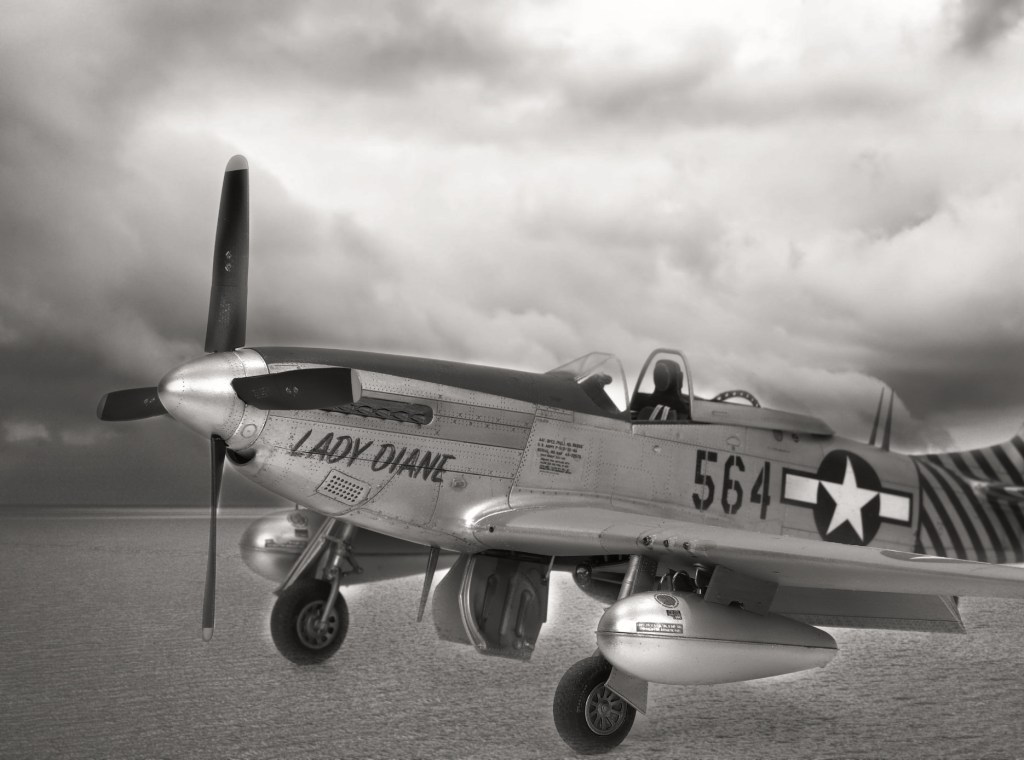
I decided to build it as the 506th FG / 458th FS P-51 flown by 2Lt. Robert Harvey who was one of the 24 pilots of the 7th Air Force killed that day. There were no witnesses to his loss, like most of the others lost, he simply vanished.
Build
Assembly was entirely trouble free. The cockpit looks very good out of the box and I tried to do it justice. I tried to paint the main gear well with as much finesse as I could muster, representing that occasionally there would be a mix between green and yellow spars.
As always, the wing panel lines must be filled. I would be very happy for any manufacturer to represent Mustang wings properly; it’s so well known that the panel lines were mostly filled at the factory. There’s a fuller description of the wing filling requirement in my other P-51 pieces so I won’t bore with repartition here.
Click on any of the images below to scroll through the gallery.


Post major sub-component assembly I checked wing fit and was happy that it was good enough that I could paint wings and fuselage separately.
Paint
Just for fun, and for no modelling purpose whatsoever, I painted the wings as they would have been in the factory. YZC as a base, then a grey (to represent the grey epoxy applied to smooth out the finish) and red to represent the putty on the panel lines.
To represent the painted finish on the wings I used a two-stage process. First, a metallic finish (my last bottle of Testor’s Metaliser) and then a grey filter. I was really happy with how it turned out, was exactly what I was going for. I left the natural metal parts natural metal, but did make an error in leaving the ammunition bay covers natural metal; they would have been painted in the same way as the rest of the upper wing.
I used the Metaliser on the fuselage as well. It really is a fantastic finish and aft I applied a seal coat of semi-gloss clear it was ready for markings and weathering.
Click on any of the images below to scroll through the gallery.


Markings
The 506th FG / 458th Fighter Squadron used blue stripes on the tail as their markings, though later they were simplified to solid blue tails. By looking at contemporary photos and cross referencing serial numbers I decided that it was likely Harvey’s Mustang had stripes.
Research (see references) had given me the serial and callsign number for his aircraft, I found one source that reported his aircraft was named “Lady Diane.”
The design for “Lady Diane” was entirely mine, there’s no photo I could find of #564 to get a suggestion. I did try to make it somewhat of the same style as other aircraft in the squadron. The number itself was easy to paint though I was very nervous about lifting paint with the mask. The rest of the markings were decals. I used some Tamiya decals for the US insignia but otherwise I used the decals from the box. I found the best way to deal with the Eduard peel-able decals was to apply them on oftener, leave them for a few minutes and then press them down. After that, do nothing. The decals dried out nicely in about 12 hours, I tended to leave them for a day or more. Once they were completely dry a little lift with tweezers or even a bit of tape to the corner of the top film would be enough to lift it. It was a simple matter after that to simply preen the film off.
I needed to touch up the stripes a little but overall I was impressed with how they worked.
Click on any of the images below to scroll through the gallery.


A simple scheme easily accomplished. I’m sorta, kinda, liking the Eduard decals but they’re unnecessarily finicky in my opinion for not a lot of gain in terms of the finish.
Weathering
These aircraft were well used but not dilapidated. I already had a sealing coat on the NMF and I did little more than a wash which not only gave a little more emphasis to the surface detail. However, the wash and its removal also changed the overall sheen to something that looked very realistic to my eye. Not flat, not polished, just like aluminium that had been outside for a while.
Click on any of the images below to scroll through the gallery.


Finish
First thing was to join the wings to fuselage. This went without any problem.

I added the flaps which fit much better than they do on the Tamiya kit. I took some time with the undercarriage and fuel tanks. I plumbed the tanks into the wings.
Click on any of the images below to scroll through the gallery.


Summary
The Eduard Mustang is a truly great kit, easily my favourite 1/48 P-51 over the Tamiya and Airfix offerings. The latter two have a place though; I’ll use the Tamiya and Airfix kits in the stash for camouflaged and/or painted subjects, but for NMF it will always be the Eduard from now on. I have two more in the stash but am yet to decide on subjects for them.
Gallery


References and Sources
There are a lot references for the 7th Fighter Command and the Mustangs at Iwo Jima. One of my primary references for this piece was “The Pineapple Airforce” by John Lambert which is, in my opinion at least, the definitive publication on the topic. I also referred heavily to “Very Long Range P-51 Mustang Units of the Pacific War” by Carl Molesworth
The online references used were as follows.
- https://www.7thfighter.com/newsletter/sunsetter_spring_2008.pdf
- http://www.506thfightergroup.org/missionjune1blackfriday.asp
- https://www.506thfightergroup.org/458thfightersquadron.asp
If you are interested in following the build as it unfolded, as well as the research that led to the choice of markings, the full build diary is logged in the Britmodeller Aircraft WIP Section.
I really hope you enjoyed this article!
Making-History is a labour of love for me, but it’s becoming more expensive and time consuming. I’m loath to put advertising on it, so if you feel inclined please consider making a donation to help cover site hosting costs as well as the time it takes to produce its content. All donations get a receipt with my thanks.
Mark.
Make a one-time donation
Make a monthly donation
Make a yearly donation
Choose an amount
Or enter a custom amount
Your contribution is very much appreciated and 100% of it will be recycled back into Making-History.
Your contribution is appreciated.
Your contribution is appreciated.
DonateDonate monthlyDonate yearlyCopyright ©2024
This article, its text, and photos of the model is my original work and is protected by copyright in its entirety, except where noted. All research sources are listed in the References and Sources section above, including photos from official sources. All other images and quoted content were sourced from the internet and are used here under protection of fair-use. Any copyrighted content will be happily removed and/or credited forthwith upon request by its rightful owner.


 Making-History
Leave a comment